

What Is Hunter S. Thompson's Real Name? Raoul Duke, Dr. Gonzo and the Man Behind Them
Hunter S. Thompson → Hunter Stockton Thompson
Hunter S. Thompson's real name is Hunter Stockton Thompson.
- Known as
- Hunter S. Thompson
- Real name
- Hunter Stockton Thompson
- Also known as
- Hunter S. Thompson, HST, Raoul Duke, Dr. Thompson, "the Good Doctor"
- Born
- July 18, 1937, Louisville, Kentucky
- Died
- February 20, 2005, Woody Creek, Colorado (age 67)
- Known for
- Inventing Gonzo journalism; Hell's Angels (1967), Fear and Loathing in Las Vegas (1972), Fear and Loathing: On the Campaign Trail '72 (1973)
- Signature
- The two-thumbed Gonzo fist clutching a peyote button
- Category
- Writers
Hunter S. Thompson's real name was Hunter Stockton Thompson (July 18, 1937 – February 20, 2005). The American journalist and author created "Gonzo" journalism and often wrote through alter egos, most famously "Raoul Duke" in Fear and Loathing in Las Vegas. He also styled himself "Dr. Hunter S. Thompson"; the "Doctor" title came from a mail-order ministry, not a university.
Quick facts
Is Hunter S. Thompson his real name?
Mostly, yes. Unlike many entries on realnameof.com, "Hunter S. Thompson" isn't a made-up pen name. It is his legal name with the middle name shortened: the "S." stands for Stockton, a family name on his mother's side. (Britannica)
What makes him a real-name story is everything he layered on top of it. Thompson wrote some of his most famous work through a fictional stand-in, Raoul Duke, and he signed letters, introductions and press releases with invented titles and personas. Readers often couldn't tell where Thompson ended and Duke began, and that blur was the point.
His main aliases and alter egos:
- Raoul Duke – the narrator of Fear and Loathing in Las Vegas and a recurring byline and character across his work. Duke even appears as a credited "contributor" on Rolling Stone mastheads.
- Dr. Hunter S. Thompson / "the Good Doctor" – Thompson bought a Doctor of Divinity credential through a mail-order church and used "Dr." for the rest of his life, mostly as a joke on authority.
- Uncle Duke – not Thompson's own creation, but Garry Trudeau's Doonesbury character, modeled on him starting in the 1970s. Thompson was irritated by it at first but later said he had made peace with it: "I got used to it a long time ago... It no longer bothers me." (CNN, 2005)
- "Dr. Gonzo" – the name of his attorney sidekick in Fear and Loathing in Las Vegas, based on his real friend, Chicano lawyer and activist Oscar Zeta Acosta. Thompson was Duke; Acosta was Dr. Gonzo.
Early life in Louisville
Hunter Stockton Thompson was born on July 18, 1937, in Louisville, Kentucky, the eldest of three sons of Jack Robert Thompson, an insurance adjuster, and Virginia Ray Davison Thompson. The family lived in the leafy Cherokee Triangle–Highlands area. (Britannica)
His father died in 1952, when Hunter was 14, leaving his mother to raise three boys on a modest income. Biographers trace much of his later rebelliousness to that loss and to the sense of being a smart, scrappy kid on the edges of Louisville's upper-crust society. (E. Jean Carroll, Hunter: The Strange and Savage Life of Hunter S. Thompson, 1993)
Even as a teenager he was writing. He was accepted into the Athenaeum Literary Association, an exclusive club for Louisville high school boys, where he published essays and stories in its yearbook, The Spectator. But he was also a troublemaker. In 1955 he was charged as an accessory to robbery after being in a car with the robber. He was sentenced to 60 days in the Jefferson County jail, served 31, and wasn't allowed to take his final exams, so he never graduated with his class. The Athenaeum expelled him. (The New York Times; William McKeen, Outlaw Journalist, 2008)
Louisville stayed in his work for life. He returned to his hometown to cover the 1970 Kentucky Derby in the article that birthed Gonzo, and today the city remembers him as a native son, despite his complicated feelings about it.
Air Force years
Shortly after his release, Thompson joined the U.S. Air Force in 1956. He trained in electronics, then talked his way into a job at the base newspaper at Eglin Air Force Base in Florida, the Command Courier, where he became sports editor. In early 1957 he also wrote a sports column for The Playground News, a civilian paper in Fort Walton Beach, but without his name on it, because Air Force rules banned outside work. (Britannica; McKeen, Outlaw Journalist)
His superiors weren't amused by his attitude. In 1958 he received an early honorable discharge, after Col. William S. Evans, the base's chief of information services, wrote that "this airman, although talented, will not be guided by policy" and that "sometimes his rebel and superior attitude seems to rub off on other airmen staff members." Thompson later wrote a mock press release about his own exit. The episode set a pattern: talent and nerve paired with zero respect for rules.
Early journalism and the wandering years
After the Air Force, Thompson bounced through a string of short-lived jobs. He worked as a copy boy at Time magazine in New York and took classes at Columbia University's School of General Studies. At work he typed out parts of F. Scott Fitzgerald's The Great Gatsby and Ernest Hemingway's A Farewell to Arms to learn their rhythms and style. (Rolling Stone)
He was fired from Time for insubordination and then from the Middletown Daily Record in upstate New York after a run-in with an advertiser and damage to an office candy machine. In 1960 he moved to San Juan, Puerto Rico, to write for a sports magazine called El Sportivo, which folded soon after. His Puerto Rico experiences fed his first novel, The Rum Diary, which he wrote in the early 1960s but didn't publish until 1998. (Britannica)
His first real break came from the National Observer, a Dow Jones weekly, which sent him to South America as a correspondent in 1962–63. His dispatches from Colombia, Peru and Brazil showed the vivid, personal voice that would later explode into Gonzo. He then lived for a time in Big Sur, California, worked as a security guard there, and wrote about the area's bohemian scene.
In 1963 he married Sandra Dawn Conklin. Their son, Juan Fitzgerald Thompson, was born in 1964 (named partly for F. Scott Fitzgerald). The couple settled in the San Francisco area, where the counterculture was beginning to boil, and later moved to Woody Creek, outside Aspen, Colorado, where he bought the property he named Owl Farm. He lived there for the rest of his life. (Britannica)
Hell's Angels: his first big book
In 1965 Carey McWilliams, editor of The Nation, asked Thompson to write about the Hells Angels motorcycle club, then the subject of a lurid California attorney general's report. His article, "The Motorcycle Gangs: Losers and Outsiders," ran that May and brought him book offers. (The Nation)
Thompson spent about a year riding and drinking with the Angels, mostly with the club's Oakland and San Francisco members. The result, Hell's Angels: The Strange and Terrible Saga of the Outlaw Motorcycle Gangs (Random House, 1967), was a best seller that mixed reporting with sharp media criticism: Thompson showed how newspapers and magazines had hyped the gang into a national menace. (Britannica)
The relationship ended badly. The bikers came to feel he was profiting off them and wanted a cut. In 1966 an argument at a party ended with several Angels giving him a savage beating (a "stomping" in club slang) after he stepped in when a member was abusing a woman and a dog. Thompson described it at the end of the book. (The New York Times, "On the Wild Side") The beating became part of his legend: the reporter who got too close to the story, and wrote about that too.
Hell's Angels made him a name. It also showed his central method: put himself in the middle of the story and make his own experience part of the reporting.
"The Kentucky Derby Is Decadent and Depraved" and the birth of Gonzo
In 1970, Scanlan's Monthly sent Thompson home to Louisville to cover the Kentucky Derby. They paired him with a young British illustrator he'd never met, Ralph Steadman. Thompson failed to deliver a normal race story. Instead, against a deadline, he tore pages from his notebook and sent them in, producing an article about the drunken, sunburned crowd and his own descent into chaos. The horses barely appear. (Britannica; Library of Congress)
The piece, "The Kentucky Derby Is Decadent and Depraved," ran in June 1970 with Steadman's ink-splattered caricatures. Thompson thought it was a failure. Readers and other writers thought it was something new.
Bill Cardoso, then editor of The Boston Globe Sunday Magazine, wrote to Thompson praising the piece as "pure Gonzo." Steadman later recalled Thompson saying, "Okay, that's what I do. Gonzo." (The New York Times, 2006) The word, possibly Boston Irish or French-Canadian slang for the last man standing after an all-night drinking bout, stuck. Thompson adopted it, and "Gonzo journalism" came to mean a first-person style where the reporter becomes the main character, subjective truth trumps neutral fact, and the line between reporting and fiction is deliberately smudged. (Merriam-Webster; The New York Times)
Steadman became his longtime visual partner, and his drawings defined how readers pictured Thompson's world.
Fear and Loathing in Las Vegas and the birth of Raoul Duke
In 1971, Thompson went to Las Vegas with Oscar Zeta Acosta. Sports Illustrated had asked him for captions about the Mint 400 desert motorcycle race; it rejected his long, unruly manuscript. He went back to Vegas soon after to cover a National District Attorneys Association drug conference, and he turned both trips into a single feverish narrative.
Rolling Stone published it in two parts in November 1971 under the byline Raoul Duke, with Steadman's illustrations. Random House released it as a book in 1972: Fear and Loathing in Las Vegas: A Savage Journey to the Heart of the American Dream. (Britannica; Rolling Stone)
In the story, Raoul Duke and his "300-pound Samoan attorney" Dr. Gonzo drive into the desert with a trunk full of drugs. Its opening line, "We were somewhere around Barstow on the edge of the desert when the drugs began to take hold," is one of the most quoted in American writing. Under the comedy, the book is an elegy for the 1960s and a dark look at what happened to the American Dream.
Why use a pen name for the most autobiographical book he ever wrote? Raoul Duke gave him cover and freedom. Duke could do and say things a journalist couldn't admit to under his own name, and the alter ego let Thompson blur memoir and fiction. Acosta, the real Dr. Gonzo, disappeared in Mexico in 1974 and was never found.
Raoul Duke lived on far beyond Vegas, appearing as a byline, an alias, and a character for decades.
Rolling Stone and the 1972 campaign
Rolling Stone founder Jann Wenner gave Thompson a platform as the magazine's "National Affairs Desk." In 1972 he covered the presidential race from start to finish, filing long, opinionated, often hilarious dispatches. They were collected as Fear and Loathing: On the Campaign Trail '72 (1973), still one of the most celebrated books on American politics. (The New York Times, 1973 review)
Thompson championed George McGovern, savaged Richard Nixon, and treated the campaign press corps, the "Boys on the Bus," with a mix of affection and scorn. Frank Mankiewicz, McGovern's campaign director, often described it as the "most accurate and least factual" account of the campaign.
The Muskie Ibogaine hoax
The 1972 campaign also produced Thompson's most notorious prank. In a dispatch about the Wisconsin primary, he wrote that front-runner Sen. Edmund Muskie of Maine had been seen behaving strangely and joked that Muskie might be under the influence of Ibogaine, an obscure African psychoactive drug. He presented it as a "rumor" circulating among insiders.
There was no such rumor; Thompson made it up. But some readers and even journalists took it seriously, and it fed a narrative that Muskie was emotionally unstable, already fueled by his tearful moment in New Hampshire. Muskie's campaign collapsed later that spring for many reasons, but the Ibogaine story became part of the legend. Thompson later said he never thought anyone would believe it. (The New York Times, 1972; Not Even Past, UT Austin)
The hoax got a fresh life in 2026 when it came up on The Joe Rogan Experience. See our news coverage: JRE 2570 and Thompson's Muskie hoax.
The Freak Power campaign for sheriff
Before the 1972 campaign, Thompson ran for office himself. In 1970 he was the "Freak Power" candidate for sheriff of Pitkin County, Colorado, which includes Aspen. He shaved his head so he could call his crew-cut Republican opponent "my long-haired opponent," and his platform included renaming Aspen "Fat City" to scare off developers, decriminalizing drug use (while punishing dishonest dealers), and replacing paved streets with sod. He lost to incumbent Sheriff Carrol D. Whitmire, 1,533 votes to 1,065. (Britannica; Freak Power: The Ballot or the Bomb, 2020 documentary)
He lost, but closely enough to scare Aspen's establishment, and the campaign helped spark a wave of local activism that reshaped the town's politics. He wrote about it in Rolling Stone in "The Battle of Aspen," one of his first pieces for the magazine.
Later life: fame, columns and Owl Farm
By the mid-1970s, Thompson was a celebrity, and that changed his work. Fans expected the wild Gonzo character, and he often obliged. Assignments to cover the 1974 "Rumble in the Jungle" fight in Zaire and the fall of Saigon in 1975 produced legendary stories, but sometimes not the articles editors wanted. (The New York Times)
His writing was gathered in the "Gonzo Papers" collections, starting with The Great Shark Hunt (1979), followed by Generation of Swine (1988), Songs of the Doomed (1990) and Better Than Sex (1994). In the 1980s he wrote a column for the San Francisco Examiner, and in 1983 he wrote The Curse of Lono about a trip to Hawaii, illustrated by Steadman. He and Sandra divorced in 1980.
In 1990, authorities searched Owl Farm after a woman accused him of assault; the charges were dropped. Thompson framed the case as a fight against overreaching police.
Later books included Kingdom of Fear (2003) and the Hey Rube columns he wrote for ESPN.com's Page 2 from 2000 until his death, collected in 2004. In 2003 he married his longtime assistant, Anita Bejmuk. His letters were published in The Proud Highway (1997) and Fear and Loathing in America (2000), edited by historian Douglas Brinkley. (Britannica)
Owl Farm, with its guns, peacocks and nearby Woody Creek Tavern, became a pilgrimage site for writers, musicians and actors.
Death in 2005 and the cannon salute
Hunter S. Thompson died by suicide at Owl Farm on February 20, 2005, at age 67. He had been dealing with serious health problems, including a broken leg and hip surgery. His son Juan found his body. In 2025 Colorado investigators reopened the case after questions were raised, and in January 2026 they confirmed they had found no evidence it was anything other than suicide. (The New York Times, 2026) Days before, he had written a short note, later published, titled "Football Season Is Over," reflecting on his age and frustration with his health. (Rolling Stone, via archive; CNN)
If you or someone you know is struggling, you can call or text 988 to reach the 988 Suicide & Crisis Lifeline in the U.S.
Thompson had long said he wanted his ashes fired from a cannon. On August 20, 2005, his wish came true. At a private ceremony at Owl Farm, his ashes were blasted from a cannon atop a tower shaped like the Gonzo fist, 153 feet tall, accompanied by fireworks and music. The memorial was largely funded by actor Johnny Depp, his friend. Guests included family, friends and celebrities. (The New York Times, 2005)
Legacy and film portrayals
Thompson changed American journalism. Alongside Tom Wolfe, Joan Didion and others, he's seen as a leading figure of the "New Journalism," but Gonzo was all his own: a personal, comic and furious style that put the writer at the center. Generations of bloggers, podcasters and magazine writers owe something to it. (Library of Congress; Britannica)
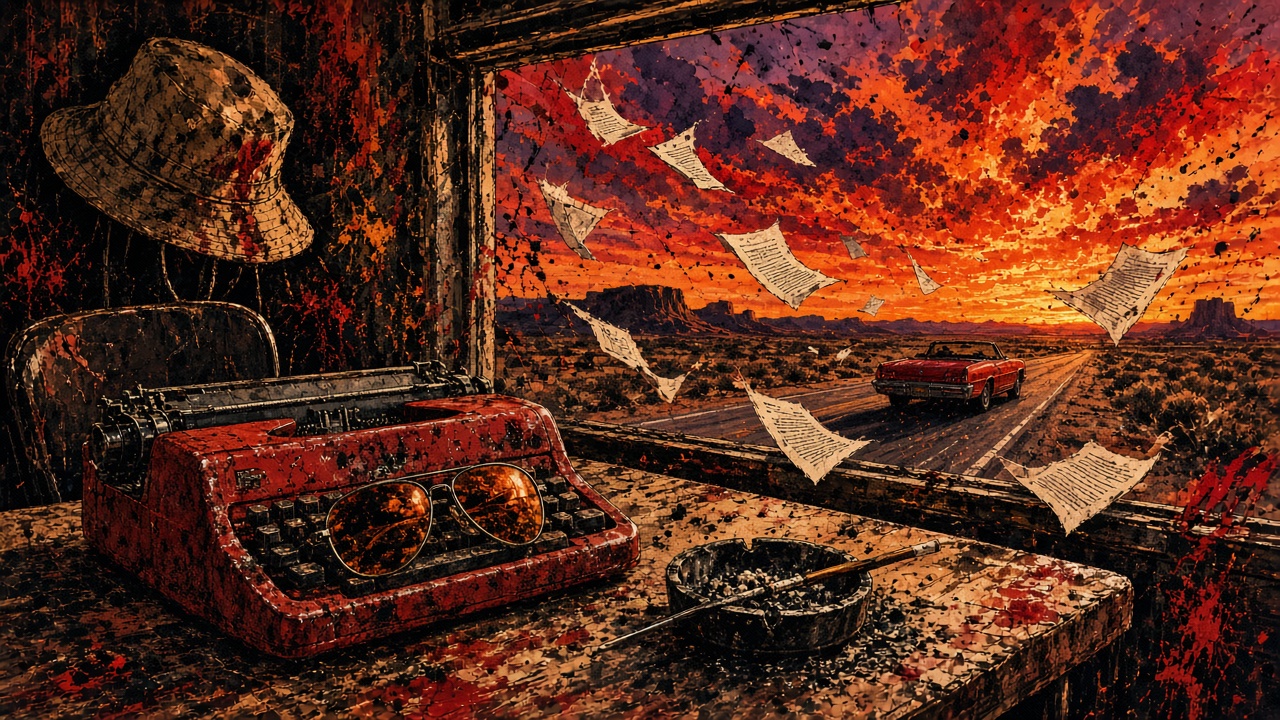
His image is just as famous as his writing: aviator sunglasses, bucket hat, cigarette holder, Hawaiian shirt. It has been portrayed many times on screen:
- Bill Murray played him in Where the Buffalo Roam (1980).
- Johnny Depp played Raoul Duke in Terry Gilliam's Fear and Loathing in Las Vegas (1998), opposite Benicio del Toro as Dr. Gonzo. Depp also starred in The Rum Diary (2011), playing a Thompson-like character.
- Alex Gibney's documentary Gonzo: The Life and Work of Dr. Hunter S. Thompson (2008), narrated by Depp, and Freak Power: The Ballot or the Bomb (2020) covered his life and politics.
His son, Juan F. Thompson, published a memoir, Stories I Tell Myself: Growing Up with Hunter S. Thompson (2016). Garry Trudeau's Uncle Duke still turns up in Doonesbury.
Today, many people know his name better than his books, but the books still sell. And the pen-name trick he used for Raoul Duke is the reason he belongs in realnameof's Writers section: one man, many masks, all of them true in their way.
News about Hunter S. Thompson


FAQ
What was Hunter S. Thompson's real name?
Hunter Stockton Thompson. The "S." stands for Stockton.
Who is Raoul Duke?
Raoul Duke was Hunter S. Thompson's alter ego and pen name, most famously the narrator of Fear and Loathing in Las Vegas (1971–72).
Who was Dr. Gonzo?
Dr. Gonzo was Raoul Duke's attorney in Fear and Loathing in Las Vegas, based on Thompson's friend, lawyer Oscar Zeta Acosta.
In the news
Sources
- Britannica
- CNN, 2005
- William McKeen, *Outlaw Journalist*, 2008
- Rolling Stone
- The Nation
- The New York Times, "On the Wild Side"
- The New York Times, 2006
- Merriam-Webster
- Rolling Stone
- The New York Times, 1973 review
- The New York Times, 1972
- Not Even Past, UT Austin
- The New York Times, 2026
- Rolling Stone, via archive
- The New York Times, 2005
- Hunter S. Thompson