

Source: full archived interview on YouTube. This article discusses an archived interview; it does not announce a new interview.
Source: full recorded interview on YouTube, published by Unsubscribe Podcast. This feature revisits a recorded conversation; video playback is not promised.
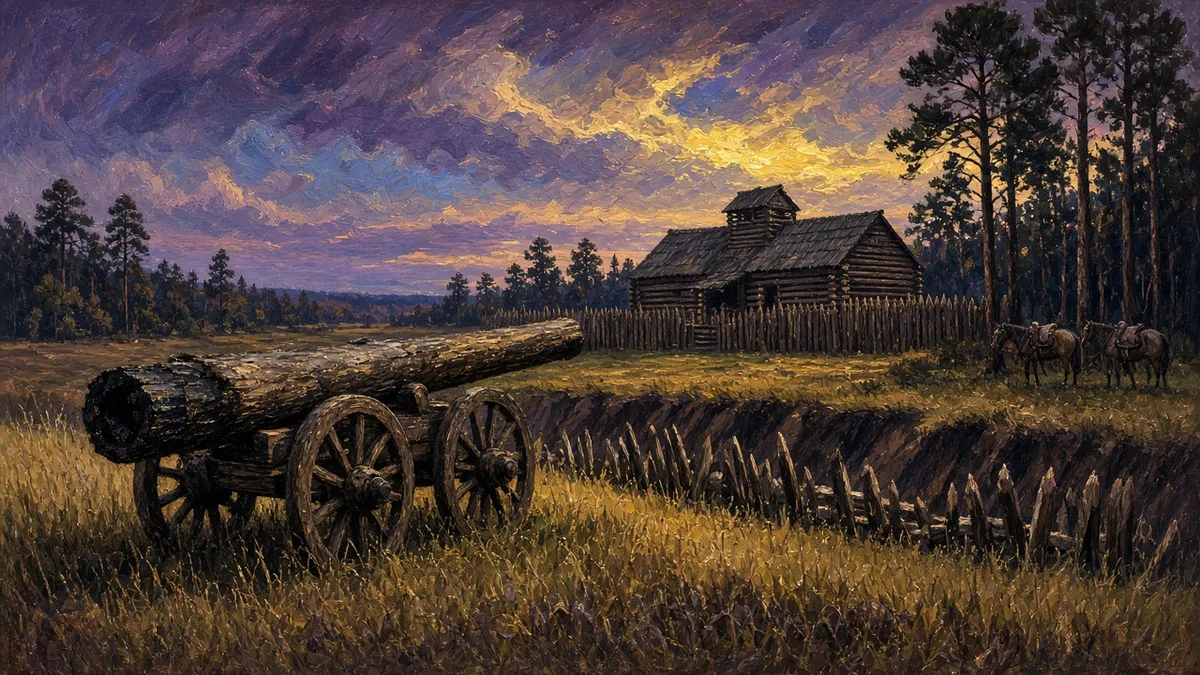
A cavalry commander confronted a fortified barn without the artillery he needed to break it open. His solution was to make the defenders believe he had brought a cannon after all. The weapon they saw was a blackened pine log mounted on wheels.
That is the central trick in Unsubscribe Podcast’s retelling of William Washington at Rugeley’s Mill. The conversation supplies modern slang and imagined exchanges; the historical accounts supply a more restrained, but still remarkable, account of the surrender.
The Washington who led the dragoons
The commander was not George Washington. The National Park Service’s biography identifies William as a distant cousin who served in the Continental Army and moved into cavalry command during the Revolution.
By late 1780, he was operating in the South with forces attached to Daniel Morgan. According to the American Battlefield Trust’s account of Rugeley’s Mill, Morgan’s men were helping protect the movement of supplies when Washington’s dragoons were released to raid the Loyalist gathering place.
The target was associated with Colonel Henry Rugeley’s plantation and trading post north of Camden, South Carolina. Its importance was practical: the location supported Loyalist activity in contested country, not simply a dramatic setting for a clever trick.
A barn built to resist an attack
The Trust describes strong log walls with firing openings, a ditch and an abatis, a barrier intended to obstruct attackers. Inside, a platform gave the defenders another level from which to fire muskets.
That helps explain the problem the podcast makes vivid. Men on horseback could move quickly across the countryside, but mobility did not give them the means to smash through a fortified building. Washington lacked an actual cannon.
The podcast dramatizes his response as an improvised solution to that mismatch. The Trust supports the essential sequence: a pine log was shaped into an imitation field piece, blackened at one end and raised onto wheels where the defenders could see it.
Making the threat look real
The bluff depended on presentation. Washington’s men brought the imitation gun forward as though preparing an artillery attack. Rugeley surrendered rather than risk the destruction of the fortified barn.
In the podcast, the story includes colorful dialogue and a threat involving a mill pond. Those words are part of the program’s telling, not treated here as authenticated eighteenth-century speech. The sources used for this feature establish the ruse without requiring a reconstructed conversation.
The surrender totals also vary. The Park Service records 112 Loyalists captured; the Trust gives 114. The podcast’s estimate is about 120. More than a hundred is the defensible common description, rather than pretending the accounts agree on an exact figure.
The wooden cannon could not fire, but that does not establish that no musket was used during the encounter. The Trust describes Washington trying muskets before concluding that he needed artillery. The podcast’s no-shot framing should not be expanded into a verified claim about the whole action.
More than a punch line
The encounter took place on December 4, 1780, in the campaign that preceded Morgan’s victory at Cowpens. The Park Service’s account places Washington’s dragoons in both episodes, connecting the smaller surrender with the wider struggle in the South.
Calling the imitation weapon a Quaker gun gives the anecdote a memorable label. Its effectiveness came from a more immediate calculation: the defenders thought they faced a weapon capable of destroying their shelter.
The archival podcast discussion makes that calculation entertaining. Reading it alongside the historical accounts keeps the achievement intact while separating the documented deception from the dialogue, rounded numbers and embellishments of a modern retelling.
FAQ
What was the imitation cannon at Rugeley’s Mill?
The American Battlefield Trust describes a blackened pine log shaped to resemble artillery and mounted on wheels.
How many Loyalists surrendered?
The National Park Service records 112, the American Battlefield Trust gives 114, and the podcast estimates about 120. The accounts agree on more than a hundred, not an exact total.