

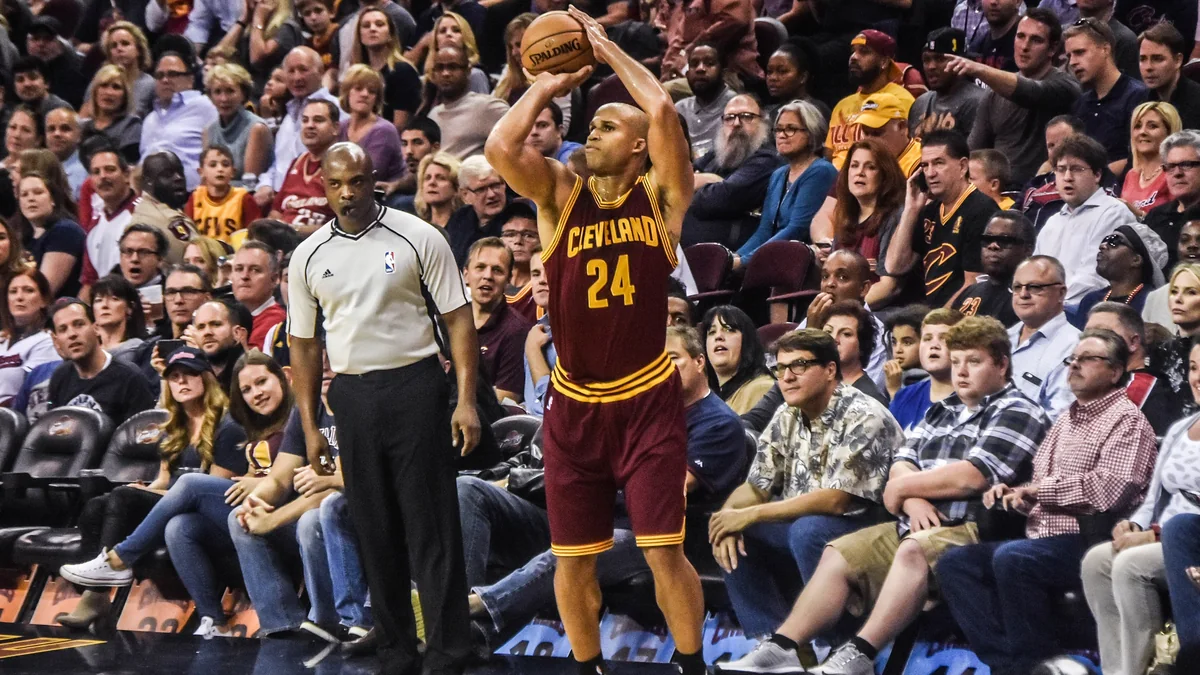

Richard Jefferson’s argument for Shaquille O’Neal and Kobe Bryant’s Lakers over Kevin Durant’s Warriors is about a specific matchup: who handles Shaq? On Club 520, Jefferson argues that O’Neal’s interior dominance would make Golden State’s smaller lineups much harder to sustain. It is an informed basketball opinion, not a result that can be proved by a game that never happened.
Clip: Viral Podcast Shorts YouTube Short from the full source linked below.
The exchange is especially interesting because Jefferson separates admiration from preference. He allows that the matchup would have made a great series while returning to the practical problem posed by a dominant center. The hosts press the other side: what happens when Stephen Curry pulls that center into defensive decisions far from the basket?
Why Jefferson keeps returning to Shaq
Jefferson recalls the physical burden of defending O’Neal. His argument is that teams needed multiple big men, partly because individual defenders accumulated fouls trying to contain him. In his proposed matchup, going small would not simply be an offensive choice; it would carry consequences at the other end.
He also pushes back against the assumption that prime O’Neal could not move well enough to compete with a perimeter-oriented team. At the same time, the exchange acknowledges an unfamiliar challenge in Curry and Klay Thompson. Jefferson points to Bryant and other Lakers defenders rather than pretending O’Neal would play the series alone.
These are competing tactical claims. They do not establish a final score, guarantee a series winner or tell us exactly how either coaching staff would adjust across seven games.
Keep the Lakers seasons straight
The conversation references the 2001 Lakers, but Jefferson also identifies the 2002 team that swept his New Jersey Nets. Those are neighboring championship seasons, not interchangeable records.
The NBA’s 2001–02 season review confirms the Lakers’ 4–0 Finals victory over New Jersey. It records O’Neal averaging 36.3 points and 12.3 rebounds in that series while earning his third consecutive Finals MVP award. Those figures explain why Jefferson’s memory of the matchup carries such force.
The Lakers’ official review of O’Neal’s accomplishments separately records their 15–1 championship run in 2001. A discussion can draw on both teams’ strengths, but it should not attach that postseason record to the 2002 season.
The clip’s references to different Warriors big men should not be treated as a single fixed roster. Comparing a dynasty also means specifying the season.
Golden State’s own 2017 season review records a 16–1 championship postseason. The Warriors swept their first three playoff series before beating Cleveland in the Finals. Their historical case does not disappear because Jefferson prefers the Lakers.
This is not a brand-new Jefferson position
An NBC Sports Bay Area article published in June 2020 documented a similar Jefferson argument on ESPN’s The Jump. He emphasized O’Neal’s ability to disrupt small-ball personnel choices. The article countered with the Warriors’ perimeter attack and the defensive demands it could place on Shaq.
That earlier coverage makes the new exchange more useful as a renewed debate than as a sudden reversal. Jefferson has previously explained this preference, and the objection remains recognizable: solving one end of the floor does not automatically solve the other.
The strongest conclusion is narrower than declaring an imaginary champion. Jefferson believes Shaq would force Golden State away from its preferred approach. The hosts question what Curry and Durant would force the Lakers to change. Both questions belong in the comparison; neither can be settled by nostalgia alone.
FAQ
Did Jefferson play against the Lakers team he mentions?
Yes. His New Jersey Nets lost the 2002 Finals to the Lakers in a sweep.
Is this a prediction backed by an actual series?
No. It is a hypothetical cross-era matchup supported by historical records and basketball analysis, not a played result.