

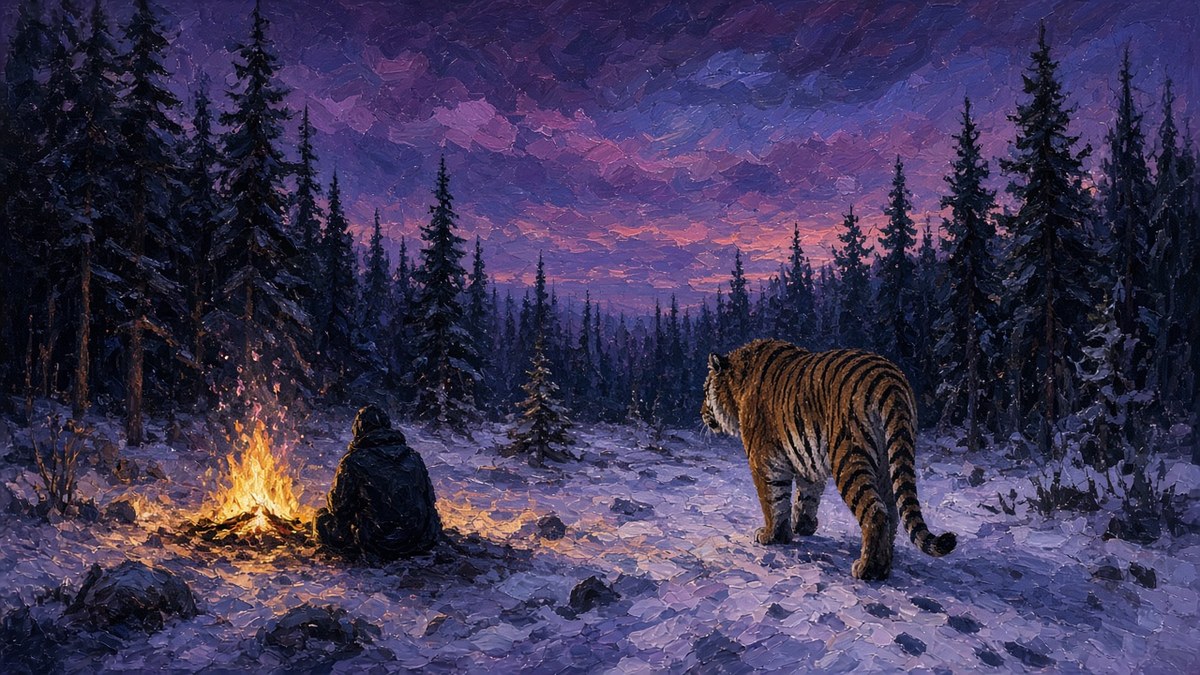
You might expect a story about meeting a tiger in the wild to end with someone running or someone firing. The one Robert Greene tells on Modern Wisdom ends with a conversation. In his retelling, a guide named Dersu Uzala talks to the animal, and it walks away.
Clip: Viral Podcast Shorts YouTube Short from the full source linked below.
The segment in the Short is Greene's version of the story, told in conversation on the show. The details below are his telling as it appears in the clip, not a historical account checked against other records.
An explorer and a stranger at the fire
Greene begins with a Russian explorer at the turn of the 20th century. The explorer's name, he says, is Arsenyev. Arsenyev was sent out to map the region. Greene describes him as a scientist. "Very good scientist, a cartographer," he says of Arsenyev, a man moving through an area that was very wild and where, in Greene's words, no Russian had been before.
At one point the group is camped and sitting by the fire. An indigenous man named Dersu Uzala asks if he can sit by their fire with them and smoke his pipe. Greene describes him as a trapper and a hunter who lives by himself.
Arsenyev asks him to join the expedition. "We need somebody like you," as Greene tells it. Dersu agrees and becomes their guide.
The tiger
Then comes the turning point. One day, Greene says, they hear a tiger roaring. Arsenyev is terrified. The tiger seems about to pounce on them, so he picks up his rifle and is about to shoot.
Dersu tells him to put it away.
A guide who talks instead of shoots
What Dersu does next is the heart of Greene's retelling. He walks right up to the tiger and starts talking to it.
According to Greene, Dersu believes "the tiger is the soul of the jungle." If you mess with that, Greene says, you are going to pay a price, and nothing in the forest will ever cooperate with you again.
So Dersu speaks to the animal directly. He calls it Amba, which Greene explains is the name his group uses for the tiger. "Don't be mad," Dersu says in Greene's retelling. "We're here just walking around. We're not going to bother you. Please be okay."
"The tiger walks away," Greene says.
"I would never be your friend"
Afterward, Arsenyev asks Dersu whether he was terrified. The answer, as Greene tells it, is no, never. Then Dersu adds the line that turns the scene into something more than a close call. If Arsenyev had shot the tiger, he says, "I would never be your friend."
The point is not only that Dersu stayed calm. In Greene's telling, shooting the animal would have been serious enough, in Dersu's eyes, to end their friendship.
What Arsenyev came to see
Greene closes the segment with what the explorer took from it. Arsenyev, he says, "comes to realize that this man has an intelligence and spirit that humans have lost."
That is the idea Greene draws out of the story. The scientist was there to map the land, and he reached for a rifle when the tiger appeared. The guide had something Arsenyev did not: a way of relating to the animal and the forest around him that the explorer came to see as a kind of intelligence of its own.
Greene does not present it as a lesson with rules attached. He tells the story and lets the image of a man simply talking to a tiger, and the tiger walking away, carry the point on its own.
This article covers only the Dersu Uzala segment shown in the Short. The fuller conversation is in the full video.
Related reading
- Robert Greene on the neuroscientist whose stroke felt like heaven
- Bugzy Malone on the uppercut that taught him to believe in himself (Modern Wisdom)
- History on RealNameOf
FAQ
Who was Dersu Uzala, according to Robert Greene?
Greene describes him as an indigenous trapper and hunter who lived by himself and became the guide for explorer Arsenyev's expedition.
What happened with the tiger?
In Greene's retelling, Arsenyev raised his rifle, Dersu told him to put it away, walked up to the tiger, spoke to it, and the tiger walked away.
What did Dersu say to the tiger?
As Greene tells it, he called it Amba and told it not to be mad, that they were only walking around and would not bother it.
What did Arsenyev take from it?
Greene says Arsenyev came to realize Dersu had "an intelligence and spirit that humans have lost."