

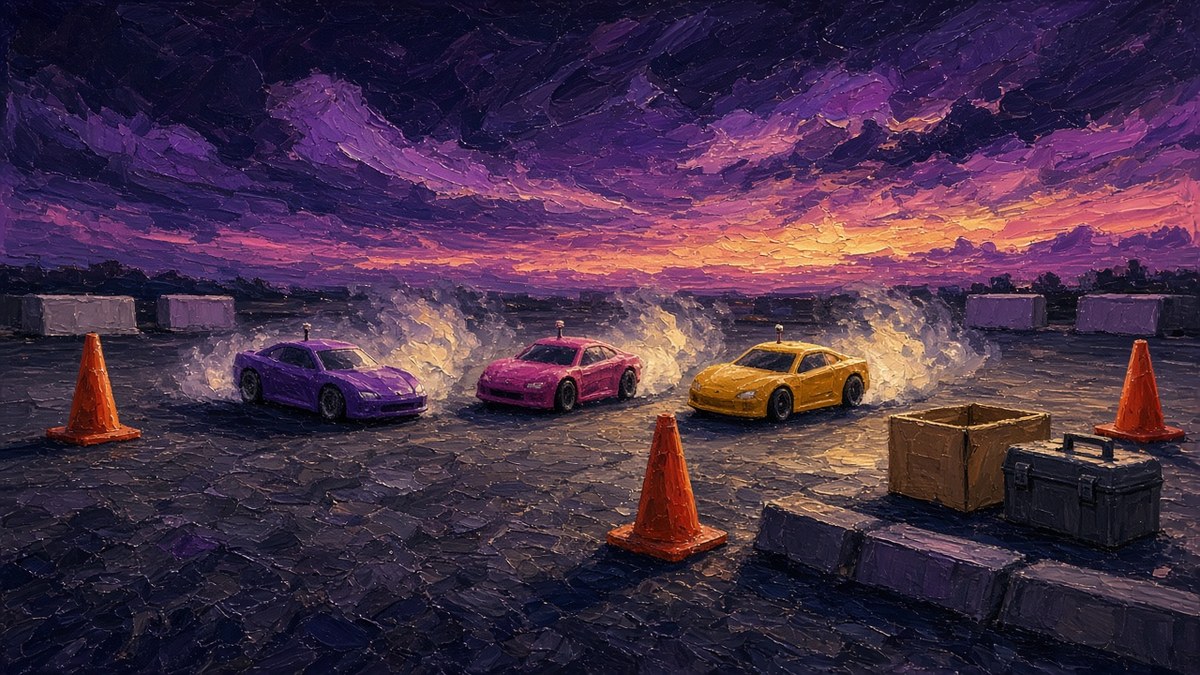
Drifting looks like a stunt. The back end slides out, the car swings around the turn and somehow keeps its speed. On Shawn Ryan Show #336, Byron Boots describes small self-driving cars that started doing exactly that, without anyone telling them to.
Clip: Viral Podcast Shorts YouTube Short from the full source linked below.
The segment in the Short is under a minute long. It covers what the cars were, what they were trying to do and how they picked up a skill on their own. The details below stay with what he says in the clip.
Small cars with computers on board
Boots starts with the setup. His team, he says, "took 1/5 scale vehicles," which he describes as smaller remote control vehicles. They put computers and sensors on them and made them autonomous.
The goal, as he frames it, was speed, and it was simple to state. "We're trying to race them as fast as possible," he says. The car is out there trying to drive faster and faster, and along the way, it is "learning how to do things like drift in order to drive even faster."
He does not name a track, a team or a specific car model in the clip, and this article does not add any.
Learning or programming?
The host asks the obvious question: is the car actually learning, or are they programming that into it?
"So it's actually learning," Boots answers. Then he walks through how the process works, step by step.
Step one: a human shows the way
It starts, he says, by "bootstrapping it." A human demonstrates how the vehicle should drive. The car then tries to replicate what the human does.
That first stage is not perfect. As the car copies the human, Boots says, sometimes it makes mistakes and sometimes it does well. The human run is a starting point, not the final answer.
Step two: the car grades itself
The next part is what makes the system more than a copy machine. Boots says the car is "kind of grading itself." It is not just repeating the demonstration. It is checking how each attempt went.
Once it can judge its own runs, it starts to experiment. Boots puts it in the car's voice: if it speeds up a little here, or brakes a little there, does that make it faster or slower?
Those are small changes. A bit more throttle in one spot, a bit more braking in another. But each one gives the car something new to compare against what it already knows.
Step three: it learns on its own
As it keeps doing that, Boots says, the car "learns how to drive faster and faster and learns on its own."
That is where the drifting comes in. Nobody wrote a rule telling the car to slide through a turn. In his telling, it got there by trying small variations, grading the results and keeping what made it quicker. Drifting turned out to be one of the things that made it faster.
Why the answer matters
The host's question is the one many people would ask. When a machine does something impressive, it is easy to assume a person scripted it ahead of time. Boots's answer is that the people involved gave the car a starting point and a way to judge itself, and the car did the rest through practice.
He keeps the explanation plain. There is no heavy jargon in the clip, just a sequence anyone can follow: watch a human, copy the human, grade the attempt, adjust a little, repeat. For anyone curious about how self-driving systems can improve with practice, that sequence is a useful way to picture it.
This article covers only the segment shown in the Short. The fuller conversation is in the full episode.
Related reading
- Tech News on RealNameOf
- Tesla's company history and the real names behind it
- Byron Tau on why 'anonymous' phone location data can still point to you, on the Shawn Ryan Show
FAQ
What kind of cars is Byron Boots describing?
He says his team took 1/5-scale vehicles, smaller remote control cars, put computers and sensors on them and made them autonomous.
Did someone program the cars to drift?
No. When the host asks, Boots says the car is actually learning. Drifting came from the car trying to drive faster.
How did the cars learn?
A human first demonstrates how to drive. The car copies that, grades its own attempts and experiments with a little more acceleration or braking to see what makes it faster.
What does "learns on its own" mean here?
In Boots's telling, after the human demonstration, the car keeps improving by testing small changes and judging the results itself.