

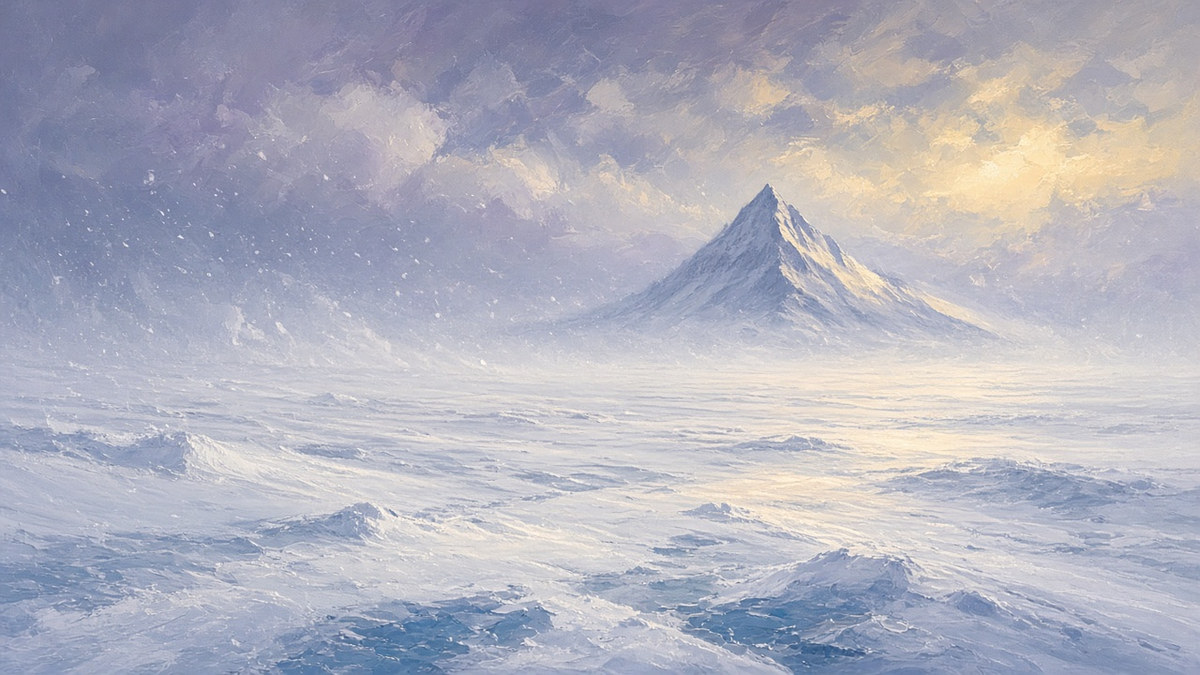
Mike Jones, the SERE specialist known online as Garand Thumb, says one of the hardest lessons of his time in the Arctic was how badly the eye judges distance in empty, snow-covered terrain. On Shawn Ryan Show #342, he recalls his team being asked how far away a nearby peak was. They guessed it could not be more than 200 yards. As he remembers it, the real answer was about 3 miles.
Clip: Viral Podcast Shorts YouTube Short from the full source linked below.
It is a short story, told in about a minute, and it is his own recollection. He even hedges the number himself: "maybe it was less, who knows."
Why distance is so hard to judge in snow
Jones starts with the general problem. Measuring distance in the desert and measuring distance in the Arctic, he says, are "very difficult" for the same reason: there are not many reference points to compare against. With nothing between you and a landmark, there is little to help you judge its size or how far away it sits.
His example is a peak in the snow. You look at it, he says, and think it "can't be more than 500 yd." The exact number is not the point. The point is that a wide field of white gives the brain almost nothing to work with.
"Cool, walk it"
Then he gets specific. His group was right by a small peak when they were asked how far away they thought it was. Their answer, as he tells it: "it can't be more than 200 yd."
The reply was an instruction: "Cool, walk it."
By his account, the walk was "like 3 mi." He says it was horrible to do because the group was already in a calorie deficit. He does not give figures for food, pack weight or how long the walk took, and this article does not add any.
He also leaves room for his teammates to disagree. He imagines them chiming in with "It wasn't that bad." His answer is that it felt that bad.
Steeper, whiteout and January in Alaska
The surprise did not stop at the distance. Once they started up, Jones says, the climb was "way longer" than he expected and "way more steep" than he expected too. The same blank landscape that hid the distance also hid the slope.
He blames that "sheet of white." On top of it, he says, conditions were often whiteout, which takes away what little visual information there is.
The timing made it harder. Jones says they were there in January, which he describes as one of the coldest months Alaska has to offer. He does not mention temperatures in the clip, and none are added here.
His summary of the experience is blunt: "Just absolutely brutal."
What the story is really about
The anecdote works because the mistake is so ordinary. Most people have misjudged how far away a hill or a building is. Jones's point is that in the Arctic, the error can be enormous, and you pay for it on foot while already low on energy and dealing with bad weather.
It also shows how the lesson was taught. Jones calls the distance guess "one of the questions," and nobody simply told the team the answer. They were sent to find out for themselves, one uphill step at a time, which is why the number stuck with him.
The lesson in the clip is practical rather than dramatic. In terrain with no landmarks, a confident guess can be off by a wide margin, and sometimes the only way to find out is to walk it.
The story comes from a much longer conversation with Shawn Ryan, but this article covers only the stretch used in the Short.
Related reading
- Wynonna Judd on how The Judds got signed on the spot at RCA, on the Shawn Ryan Show
- Royce Williams on the 263 holes in his jet, on the Shawn Ryan Show
- Frank Wright's enlistment story on the Shawn Ryan Show
FAQ
How far did Garand Thumb's team think the peak was?
On Shawn Ryan Show #342, he says the team guessed it could not be more than 200 yards away.
How far away was the peak?
As he remembers it, about 3 miles. He adds that it may have been less.
Why is it hard to judge distance in the Arctic?
He says the desert and the Arctic have few reference points for judging size and distance, and whiteout conditions make it harder still.
When did this happen?
He says they were in Alaska in January, which he calls one of the coldest months Alaska has to offer. He does not give a year in the clip.
Who is Garand Thumb?
The Shawn Ryan Show episode title describes Garand Thumb as a SERE specialist, and the Short credits him as Mike Jones.